5G in the Negev Desert: Israel Connectivity Guide
Wondering if 5G works in the Negev? Get the latest on desert mobile coverage and how an Israel eSIM provides high-speed data for your 2026 trip.
The Landscape of 5G Connectivity in the Negev
As of 2026, the Negev Desert, which encompasses roughly 60% of Israel's landmass, is no longer the cellular dead zone it once was. For travellers, researchers, and digital nomads heading south, the question of whether 5G works in the desert is central to their planning. While the vast expanse of sand and rock may suggest isolation, Israel's aggressive 5G rollout has brought high-speed data to many parts of this arid region.
However, connectivity in the Negev is not uniform. The availability of a 5G signal depends heavily on your proximity to major highways, urban centers, and strategic industrial hubs. In major southern cities like Beersheba, often called the 'Cyber Capital of Israel,' 5G coverage is robust and reliable, offering the same speeds you would expect in Tel Aviv. As you move further south toward Eilat, the coverage follows the main arteries of the country, ensuring that most travellers stay connected during their journey.
Getting ready for your trip to Israel?
Pick a plan that matches how long you are staying, and arrive already connected.
- from $28.99Choose
Basic · 20 GB
7 to 60 days
- from $34.99Choose
Medium · 50 GB
Most popular - from $44.99Choose
Pro · 100 GB
7 to 60 days
- Israeli number included
- eSIM by email in 2 minutes
- WhatsApp support
High-Speed Nodes: Where 5G Shines in the South
In 2026, several key locations in the Negev act as high-speed hubs. If your travel itinerary includes these areas, you can expect strong 5G performance on an Israeli network via your eSIM:
- Beersheba and the Northern Negev: As a major metropolitan and technological center, 5G is the standard here. This includes the Ben-Gurion University areas and the high-tech parks.
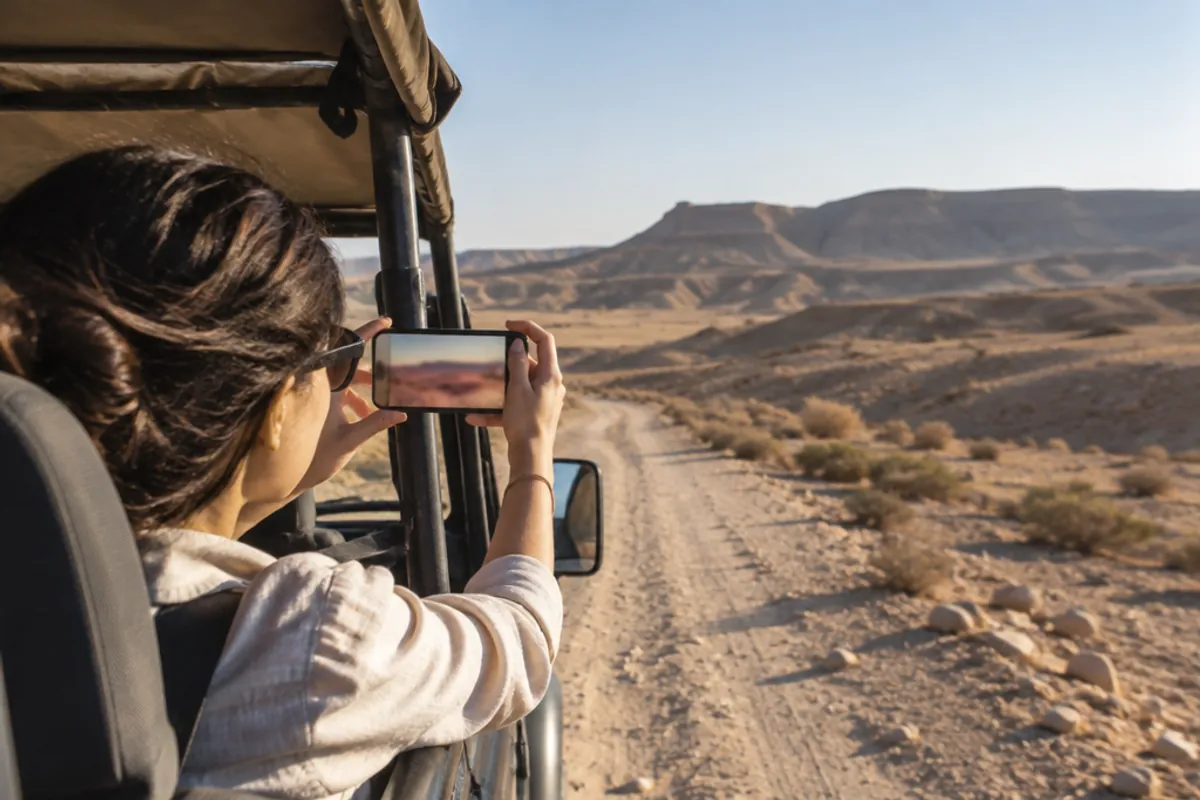
- Mitzpe Ramon: This popular destination overlooking the Ramon Crater (Makhtesh Ramon) has significantly improved its infrastructure. 5G is generally available within the town and around the visitor center, allowing for instant uploads of crater views.
- Eilat: The southernmost tip of the country is fully 5G-enabled. Whether you are at the Red Sea coast or the northern entrance of the city, high-speed data is readily accessible.
- The Arava Valley: Along Route 90, many of the kibbutzim and agricultural communities have been equipped with 5G towers to support smart farming and tourism, though some gaps between communities remain.
Navigating the Craters and Remote Trails
While 5G is expanding, the laws of physics still apply to the Negev’s unique topography. If you are hiking deep inside the Ramon Crater, Small Crater, or Large Crater, the steep rock walls can block signals from distant towers. In these remote valleys, your device will likely switch from 5G to 4G (LTE).
For those venturing into the most isolated parts of the desert, such as the deep canyons of the Eilat Mountains or the remote stretches of the Israel National Trail, you should expect intermittent connectivity. In these instances, 4G acts as a reliable fallback, providing enough bandwidth for maps and messaging even when 5G is unavailable. It is a practical reality of desert travel that the deeper you go into nature, the more likely you are to rely on lower-frequency bands that penetrate further but offer slower speeds than urban 5G.
Technical Setup for Reliable Desert Data
Staying connected in the Negev requires a device and a plan that can jump between different network frequencies seamlessly. Using an eSIM Israel solution is particularly effective for this. Because the delivery is instant via a QR code, you can set up your connection before you even leave your home or upon landing at Ben Gurion Airport. The activation process takes approximately 2 minutes, ensuring you are ready before you hit the southern highways.
A critical technical detail for any traveller using an eSIM in Israel is the APN setting. To ensure your data flows correctly across both 5G and 4G networks, your device's Access Point Name (APN) must be set to "internet". This simple configuration allows your phone to authenticate with Israeli towers correctly, preventing data drops as you move between different coverage zones in the desert.
The Advantage of Dual-SIM and Local Numbers
The Negev is a place where you want a backup. Most modern smartphones support dual-SIM functionality, allowing you to keep your home country's SIM active (for emergency SMS) while using an Israeli eSIM for all your data needs. This prevents expensive roaming charges while giving you access to local 5G speeds.
Furthermore, opting for an eSIM that includes an Israeli phone number can be a significant advantage in the south. Many national park entries, local Jeep tour operators, and remote desert lodges prefer or require a local number for coordination. Having a +972 number ensures you can receive local calls and coordinate your desert logistics without relying on third-party messaging apps that may struggle on slower data bands.
Final Practical Advice for Negev Travellers
In 2026, the Negev is more connected than ever, but the desert still demands respect and preparation. If you are planning a trek, download your maps for offline use before leaving a 5G zone. When your phone displays the 5G icon in Mitzpe Ramon or Eilat, take that opportunity to sync your photos or update your software. Once you head out into the dunes, your eSIM will handle the transition between 5G and 4G automatically, keeping you tethered to the world even in the heart of the wilderness.