Mobile Coverage Mitzpe Ramon Crater: Connectivity Guide
Stay connected in the Negev. Learn about mobile coverage in Mitzpe Ramon Crater, 5G signal availability, and how an eSIM Israel data plan works.
Understanding Connectivity in the Negev Desert
Mitzpe Ramon and the surrounding Ramon Crater (Makhtesh Ramon) represent some of the most breathtaking landscapes in Israel. However, the unique geological formation of the world's largest erosion crater presents specific challenges for mobile connectivity. For travelers visiting in 2026, understanding where signal thrives and where it vanishes is essential for both navigation and safety.
Mobile coverage in this region is generally divided into two zones: the town of Mitzpe Ramon, which sits on the northern cliff edge, and the crater floor below. While the town enjoys robust infrastructure, the wilderness inside the crater relies on a scattered network of cell towers that must contend with steep limestone walls and vast distances.
Getting ready for your trip to Israel?
Pick a plan that matches how long you are staying, and arrive already connected.
- from $28.99Choose
Basic · 20 GB
7 to 60 days
- from $34.99Choose
Medium · 50 GB
Most popular - from $44.99Choose
Pro · 100 GB
7 to 60 days
- Israeli number included
- eSIM by email in 2 minutes
- WhatsApp support
5G and 4G Network Availability in Mitzpe Ramon
In the town of Mitzpe Ramon itself, travelers can expect excellent mobile coverage. Most major Israeli networks have deployed 5G and 4G LTE infrastructure here, providing high-speed data for streaming, uploading photos of the sunset, or remote work. If you are using an eSIM from a local operator, you will likely see a full signal bar while walking along the promenade or visiting the Visitor Center.
As you move away from the town center toward the cliff's edge, the signal remains strong. However, once you begin the descent into the crater via Route 40, the signal strength fluctuates. Modern Israeli networks are optimized for the topography, but the rock density of the crater walls can lead to occasional signal attenuation. Having a local eSIM ensures you are connected to the strongest available Israeli tower, rather than relying on weaker roaming signals from international providers.
Handling Signal Dead Zones Inside the Crater
The Ramon Crater is a vast wilderness, and it is important to manage expectations regarding mobile coverage once you are deep inside. While many popular landmarks have decent reception, there are significant "dead zones" where no signal can reach.
High-Coverage Spots in the Crater
- The Sawmill (HaMinsara): Usually has reliable 4G coverage due to its proximity to the main road.
- Be'erot Campground: Generally offers stable connectivity, allowing hikers to coordinate transport or check weather updates.
- Route 40: Most of the main highway passing through the crater has consistent coverage, though it may drop to 3G in certain dips.
Low-Coverage and Dead Zones
- Wadi Holit and Deep Canyons: Once you enter narrow canyons or move far to the east or west of the main road, signal often disappears entirely.
- Mount Ardon: While the summit may catch a signal from a distant tower, the approach trails are often shielded by the mountain's mass.
For safety, hikers should never rely solely on a live cellular connection for navigation. Downloading offline maps and using a dedicated GPS tool is highly recommended when exploring the deeper parts of the Negev.
Why a Local eSIM is Essential for Desert Travel
For international travelers, using an eSIM specifically designed for Israel is the most efficient way to maintain a connection in the desert. Because an eSIM allows for instant delivery by QR code and activation in approximately two minutes, you can set up your data plan before you even reach the Negev.
One of the primary advantages of an eSIM is the dual-SIM functionality. You can keep your home country's SIM active for emergency texts while using the Israeli eSIM for all data-heavy tasks. This is particularly useful in Mitzpe Ramon, where you might need to use Google Maps or research hiking trail conditions in real-time. Furthermore, an eSIM Israel plan provides access to local 5G and 4G networks, which offer superior priority and lower latency compared to roaming services.
Another critical feature for desert travelers is the optional Israeli phone number. In the event of a mechanical breakdown or a hiking emergency, having a local number makes it significantly easier for Israeli emergency services or roadside assistance to contact you and triangulate your location.
Practical Setup for Hikers and Travelers
To ensure your mobile data works seamlessly as you explore the crater, follow these practical steps for your device configuration. Once you have scanned your QR code and installed the eSIM, the most important technical detail is the APN (Access Point Name).
For all eSIM Israel connections, the APN must be set to "internet". Without this specific setting, your device may struggle to handshake with local towers in remote areas like the Negev. Additionally, ensure that "Data Roaming" is toggled to "On" for the eSIM profile in your phone settings; this does not result in extra charges from your home provider, but it is necessary for the eSIM to bridge onto the local Israeli partner networks.
When hiking, remember that searching for a signal in dead zones drains your battery rapidly. If you find yourself in a deep canyon with no bars, it is wise to switch your phone to airplane mode to conserve power for photography and offline navigation. Once you reach higher ground or return to the main road, you can reconnect to the 5G network instantly.
Connectivity Summary for Mitzpe Ramon
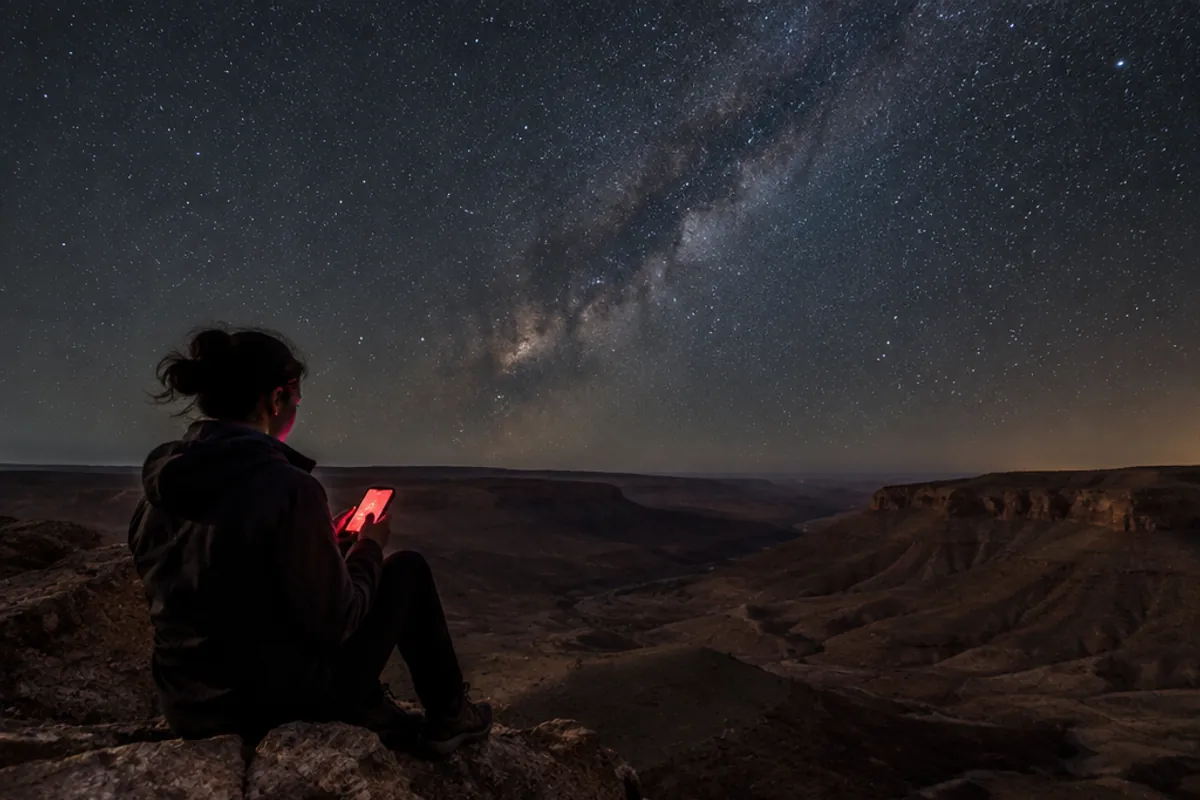
Traveling to the Ramon Crater in 2026 is easier than ever with modern mobile technology. While the desert will always have its remote corners, a local eSIM ensures that you have the best possible chance of staying connected. Whether you are stargazing in the International Dark Sky Park or trekking the Israel National Trail, reliable 5G/4G data via a local network is your most important travel tool after a bottle of water and a sturdy pair of boots.