Hanukkah is the brightest week of the Israeli winter: hanukkiot glow in windows, bakeries fill with sufganiyot and children are off school. Unlike Passover or Sukkot, it is not a public holiday — the country works as usual. But in 2026 the first and last candles are both lit on a Friday, so two Shabbats fall within the eight nights.
Hanukkah 2026 dates in Israel
| Date | Candle | What it means in practice |
|---|---|---|
| Friday 4 December | 1st candle, lit before the Shabbat candles | Eve of Shabbat: shops close early in the afternoon; buses and trains stop before sunset. |
| Saturday 5 December (evening) | 2nd candle, lit after Shabbat ends | Public transport gradually resumes during the evening. |
| Sunday 6 – Thursday 10 December | 3rd to 7th candles | Normal working days, while schools are on holiday. |
| Friday 11 December | 8th candle, lit before the Shabbat candles | Short day: shops close early and public transport stops from the afternoon. |
| Saturday 12 December (evening) | End of Hanukkah (and of Shabbat) | Transport resumes in the evening; school restarts on Sunday 13 December. |
Not a public holiday
Hanukkah is not one of Israel's official rest days: offices, shops and public transport work as usual, except on Shabbat. Only schools and kindergartens stop: according to the Ministry of Education calendar, the holiday runs from Sunday 6 to Saturday 12 December 2026, and classes resume on Sunday 13 December.
Getting ready for your trip to Israel?
Pick a plan that matches how long you are staying, and arrive already connected.
- from $28.99Choose
Basic · 20 GB
7 to 60 days
- from $34.99Choose
Medium · 50 GB
Most popular - from $44.99Choose
Pro · 100 GB
7 to 60 days
- Israeli number included
- QR code on screen right after payment
- WhatsApp support
Hanukkah in brief, for visitors
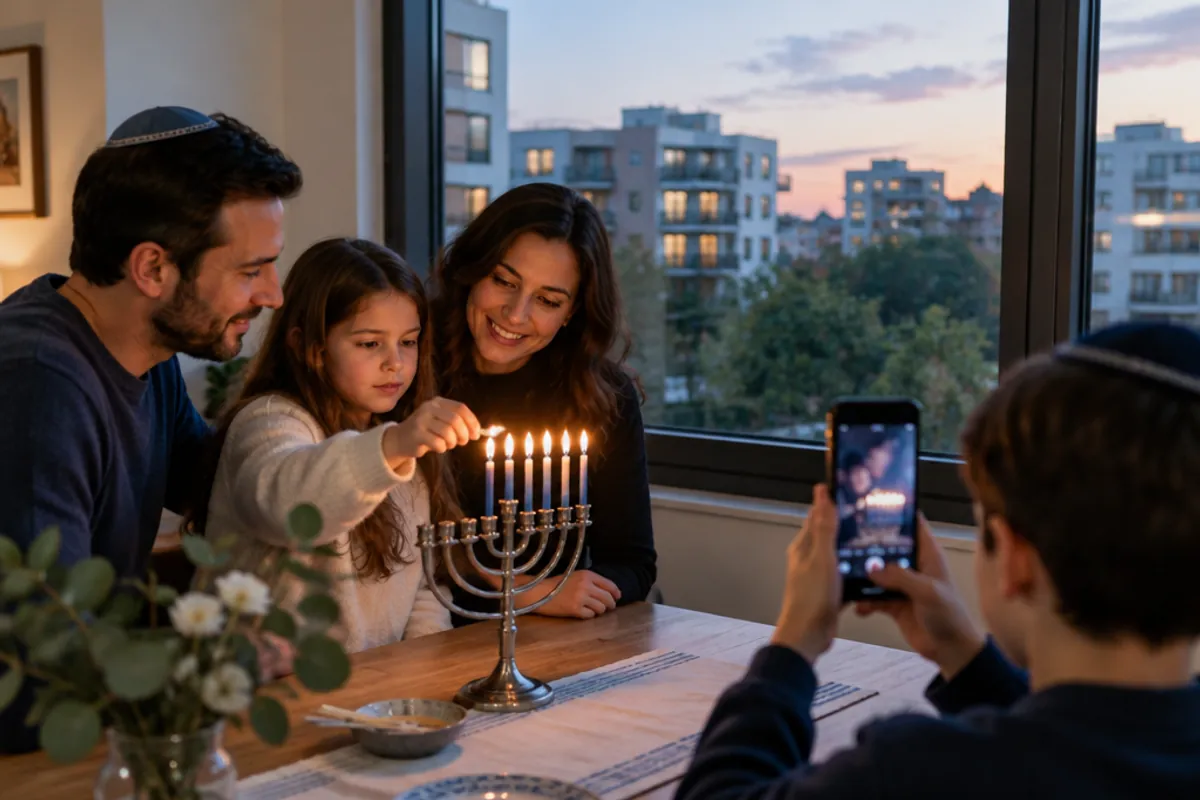
Hanukkah, the Festival of Lights, recalls the Maccabean revolt in the 2nd century BCE and the rededication of the Temple in Jerusalem, when, according to tradition, one day's supply of oil burned for eight days. Every evening families light the hanukkiah, a nine-branched lamp: one more candle each night, plus a helper candle called the shamash. Food fried in oil is the rule: sufganiyot (jam-filled doughnuts) and latkes, or potato pancakes. Children spin the dreidel (sevivon), whose letters in Israel mean “a great miracle happened here” — abroad, “there”. It is a joyful family festival, and public candle lightings are open to everyone, whatever your faith.
What is open and what changes
- Offices, shops and malls: open as usual on weekdays.
- Public transport: normal timetables, except on Shabbat — from Friday afternoon to Saturday evening on 4–5 and 11–12 December, buses and trains stop in most of the country.
- Short Fridays: many shops close early in the afternoon, and most phone shops stay shut until Shabbat ends.
- Schools and kindergartens: off from 6 to 12 December. Parents keep working, so museums, parks and children's shows are busy during the day. Some school networks (ultra-Orthodox, Arab) follow their own calendar.
The atmosphere: where to go
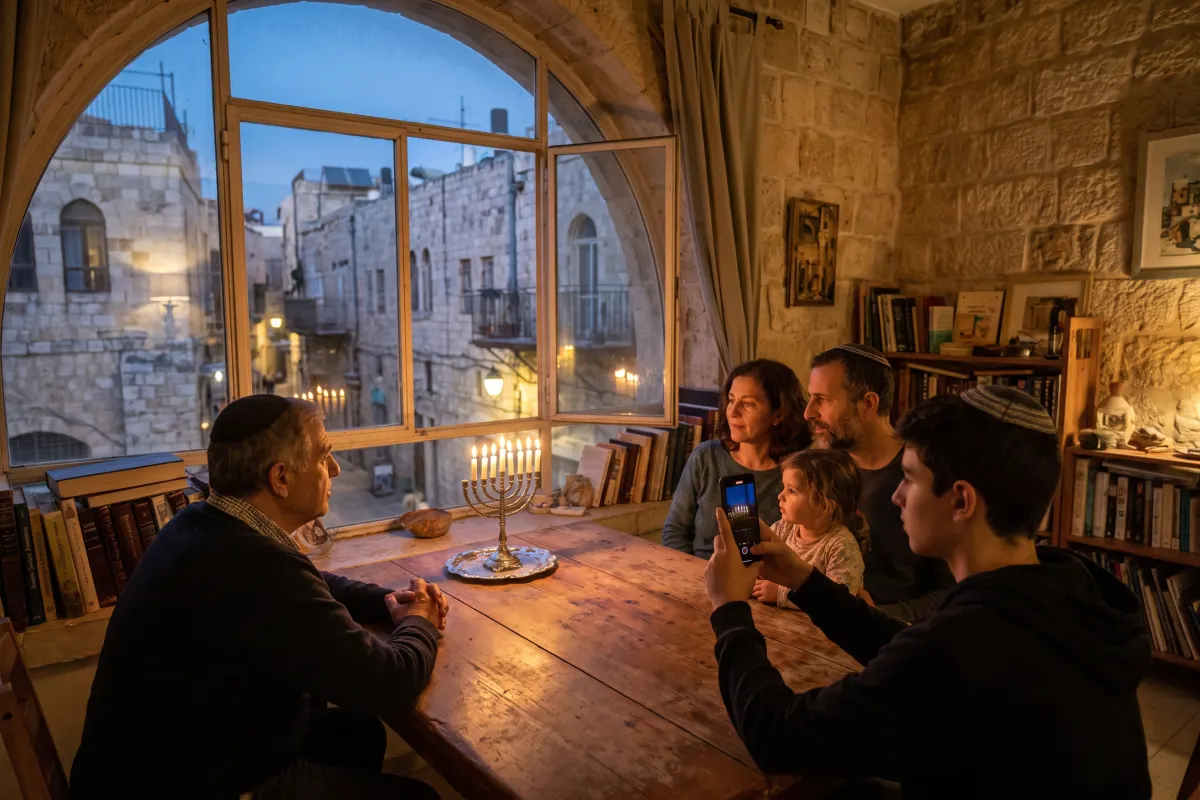
- Jerusalem: traditionally, a public candle lighting takes place every evening of Hanukkah at the Western Wall Plaza and is broadcast live online. In the evening, the alleys of the Jewish Quarter glow with hanukkiot set in glass boxes by the doors.
- Everywhere: giant hanukkiot in town squares and malls, sufganiyot in every bakery, and family activities in community centres and museums.
- Domestic tourism: the school-holiday week is the winter high season in Eilat, and hotels at the Dead Sea and in Jerusalem fill with families. Book early.
- Weather: December brings the heart of the rainy season. Evenings in Jerusalem and the north can be cold and wet, while Eilat and the Dead Sea usually stay mild and dry.
December is also Christmas season: Nazareth, Haifa and Jaffa light up with Christmas trees and decorations — a nice addition to a Hanukkah trip.
Staying connected during Hanukkah
- 1Install your eSIM before you fly, on Wi-Fi. The QR code appears on the confirmation page as soon as payment goes through, with a copy by email, so even on a Friday afternoon or on Shabbat you are online in moments.
- 2Keep your usual line for bank codes: on a dual-SIM phone, the eSIM handles data in Israel while your home number keeps receiving texts.
- 3Plan the video calls: candles are lit at nightfall (before Shabbat on Fridays). Share your connection with a tablet so grandparents abroad can watch the whole family light up.
- 4Book with your Israeli number: hotels, restaurants and activity providers call back a local +972 number more readily, and couriers and taxis can reach you.
- 5Before a public lighting or an evening in the Old City, download offline maps, share your live location and agree on a meeting point: crowds can slow mobile data.
Celebrating with an observant family?
Many observant families do not use phones on Shabbat, which this year covers two Hanukkah nights: Friday 4 to Saturday 5 December, and Friday 11 to Saturday 12 December. For a Friday lighting with relatives abroad, call a little early and hang up before Shabbat begins; on Saturday night, wait until Shabbat is over.
Which plan for a Hanukkah trip
- A week's visit for Hanukkah: a short-trip plan covers maps, messaging, photos and video calls.
- Staying on for Christmas or New Year: choose a longer plan so one plan covers the whole trip.
- Living in Israel: a monthly plan with no commitment keeps you on the same Israeli number, and you can bring your current number over.
Every prepaid plan includes a real Israeli number (+972) with unlimited calls and texts within Israel, plus 4G/5G data on the Partner network; prepaid plans work in Israel only. Need help? Our AI assistant answers on WhatsApp at any hour, and advisors are available Sunday to Thursday 9:30–19:30 and Friday 9:30–14:00 (Israel time).