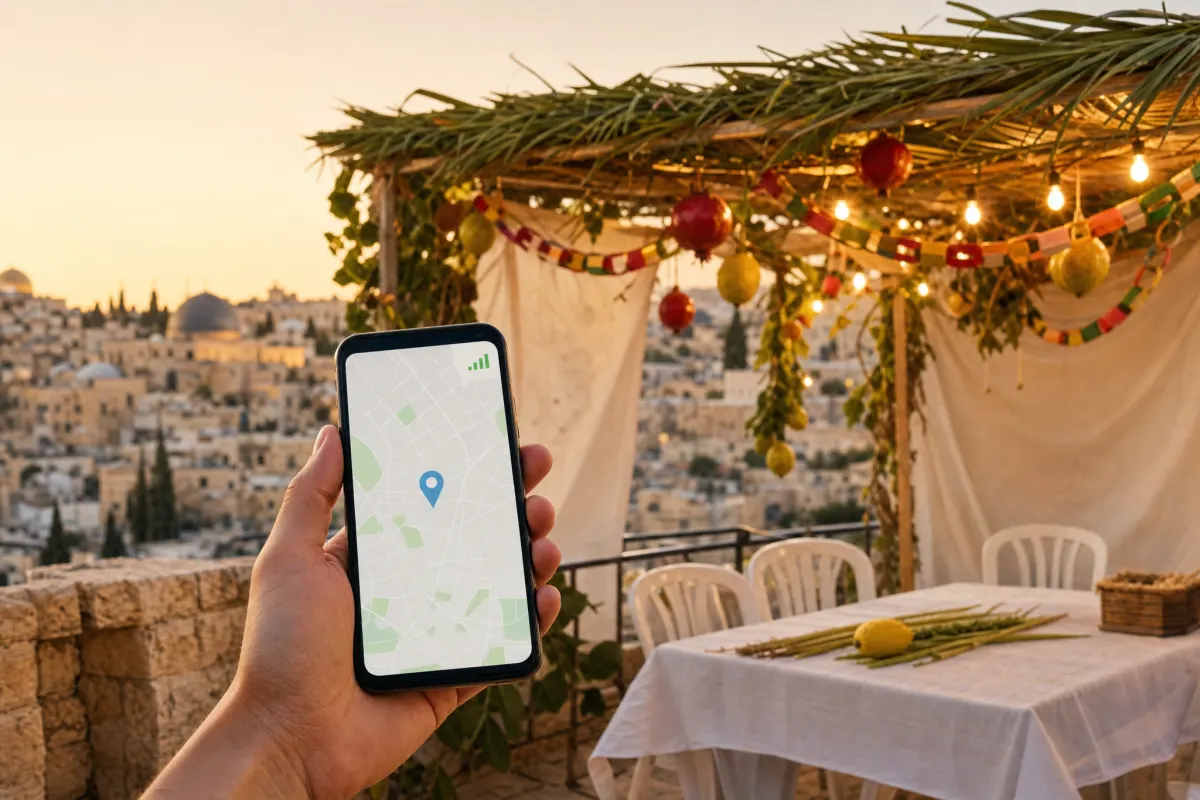
Every autumn, Israel's balconies, gardens and restaurant terraces fill with small huts roofed with palm branches. Sukkot is the most visible holiday of the Jewish year: a week-long festival that turns the whole country into a holiday destination. If you are travelling to Israel in September or October — or living here — here is what Sukkot is, how it is celebrated and how to make the most of it.
What Sukkot celebrates
Sukkot is one of the three pilgrimage festivals of the Hebrew Bible. It recalls the forty years the Israelites spent in the desert living in temporary shelters, and it marks the end of the agricultural year, when the harvest was gathered in. It is also called the “season of our joy”: after the solemn days of Rosh Hashanah and Yom Kippur, Sukkot is a joyful, outdoor holiday.
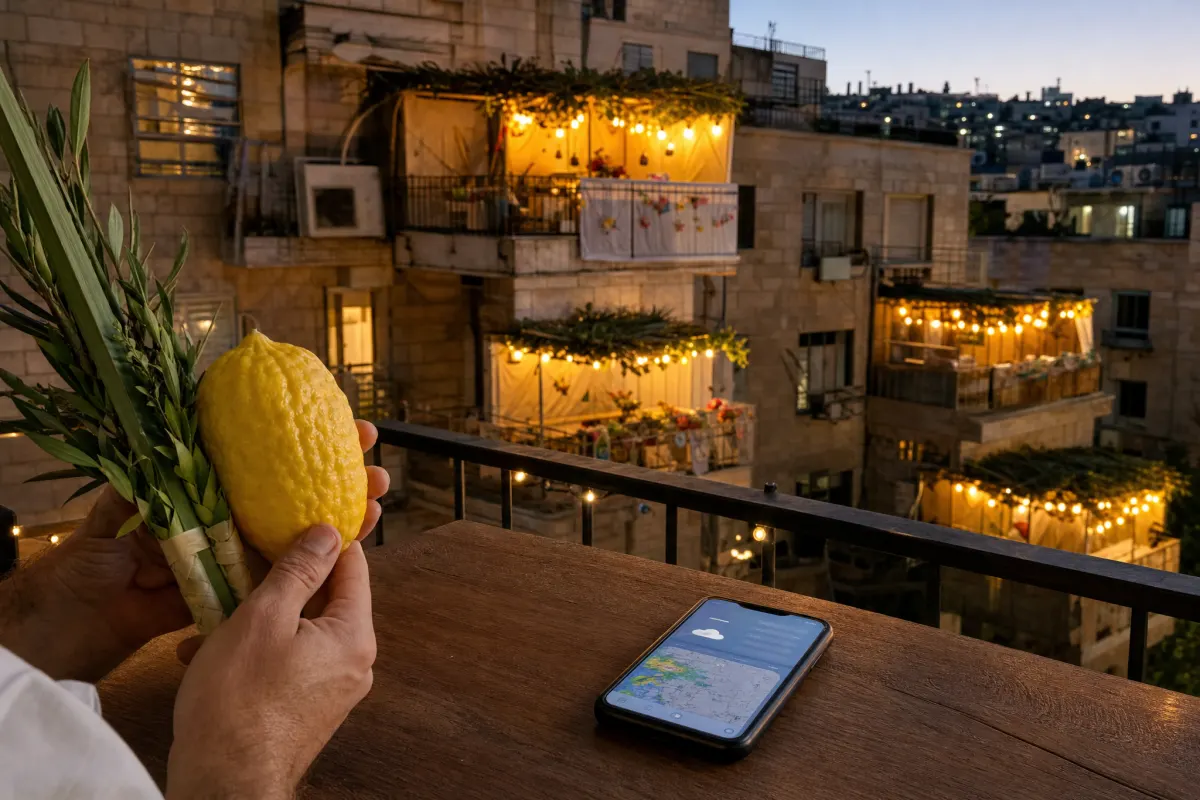
- The sukkah: a hut with at least three walls and a roof of cut branches, loose enough to see the stars through. Meals are eaten inside all week, and some people sleep in it.
- The four species: a palm frond (lulav), myrtle, willow and a citron (etrog), held together and waved during morning prayers.
- Ushpizin: the custom of symbolically inviting seven biblical guests into the sukkah, one for each night.
- Simchat Torah: on the last day, synagogues complete the yearly reading of the Torah and begin it again, with singing and dancing around the scrolls.
Getting ready for your trip to Israel?
Pick a plan that matches how long you are staying, and arrive already connected.
- from $28.99Choose
Basic · 20 GB
7 to 60 days
- from $34.99Choose
Medium · 50 GB
Most popular - from $44.99Choose
Pro · 100 GB
7 to 60 days
- Israeli number included
- eSIM by email in 2 minutes
- WhatsApp support
How Israel celebrates
- Sukkahs everywhere: on balconies, in courtyards, outside restaurants and hotels. Many kosher restaurants serve their meals in a sukkah.
- Four species markets: in the days before the holiday, pop-up markets sell lulavs and etrogs, and buyers inspect each etrog closely — a flawless one is prized.
- The Priestly Blessing (Birkat Kohanim) at the Western Wall during Chol HaMoed draws tens of thousands of worshippers.
- The Jerusalem March, traditionally held during Chol HaMoed, brings delegations from Israel and abroad through the city.
- Second hakafot: on the evening Simchat Torah ends, many towns hold open-air celebrations with music and dancing.
- Chol HaMoed trips: schools are off and families pack national parks, beaches, the Galilee and the Golan.
When is Sukkot? Dates for the coming years
Sukkot starts on 15 Tishri in the Hebrew calendar, so its Gregorian date moves every year, always between late September and late October. In Israel it lasts seven days, followed on the eighth day by Shemini Atzeret–Simchat Torah.
| Year | Starts at sunset | First day (holiday) | Chol HaMoed | Shemini Atzeret – Simchat Torah |
|---|---|---|---|---|
| 2026 | Friday 25 September | Saturday 26 September | 27 September – 2 October | Saturday 3 October |
| 2027 | Friday 15 October | Saturday 16 October | 17 – 22 October | Saturday 23 October |
| 2028 | Wednesday 4 October | Thursday 5 October | 6 – 11 October | Thursday 12 October |
| 2029 | Sunday 23 September | Monday 24 September | 25 – 30 September | Monday 1 October |
| 2030 | Friday 11 October | Saturday 12 October | 13 – 18 October | Saturday 19 October |
Dates in Israel, not abroad
These are the dates observed in Israel. Outside Israel, the first two days are both holidays, and Simchat Torah falls one day after Shemini Atzeret.
What to expect as a visitor
- The first and the last day are full public holidays: buses and trains stop from the afternoon before until nightfall, and most shops close.
- Chol HaMoed is a working week with a holiday feel: shops and sites are open, but everything is busier — book hotels, rental cars and restaurants early.
- Hoshana Rabba, the seventh day, is a short day: businesses close in the afternoon ahead of the final holiday.
- The weather is usually warm by day and cooler in the evening, and the first rains of the season sometimes arrive around this time.
Etiquette in a sukkah
- An invitation to a meal in a sukkah is a warm gesture — you do not need to be Jewish to join.
- In observant homes, phones and cameras are not used on the holiday days themselves: ask before taking photos.
- At the Western Wall, dress modestly, with shoulders and knees covered.
Staying connected during Sukkot
- 1Set up your eSIM before the holiday: it is delivered by email as a QR code and activates in about two minutes, even when shops are closed.
- 2Keep your home SIM for bank codes and use the eSIM for data.
- 3At big gatherings such as the Priestly Blessing, networks get congested: download offline maps and agree on a meeting point first.
- 4An Israeli number makes it easier to book restaurants and reach sukkah hosts and drivers.
Choose a short-trip plan for a week's visit, a longer plan to cover both holiday weekends, or a monthly plan with an Israeli number if you live here.