
In 2027 the autumn holidays arrive late: Rosh Hashanah on 2 October, Yom Kippur on 11 October, then Sukkot until 23 October. For three weeks, Israel stops, restarts and stops again. Plan your October 2027 trip around those pauses, and keep your phone ready for days when every shop is shut.
Sukkot 2027 dates in Israel
| Date | Holiday | On the ground |
|---|---|---|
| Friday 15 October | Erev Sukkot (and eve of Shabbat) | Short day: shutters come down after lunch, and the last buses and trains leave well before sunset. |
| Saturday 16 October | Sukkot, first day — also Shabbat | Full day of rest: no public transport, shops closed. The four species are first waved on Sunday. |
| Sunday 17 – Thursday 21 October | Chol HaMoed | Shops, sites and transport open; schools off, families out everywhere. |
| Friday 22 October | Hoshana Rabba | Eve of the closing holiday and of Shabbat: early closing again. |
| Saturday 23 October | Shemini Atzeret – Simchat Torah — also Shabbat | Full day of rest. After nightfall, transport resumes and many towns traditionally dance outdoors with the Torah scrolls. |
Why so late this year
The Hebrew year 5787 has an extra month (a second Adar), so Tishrei 5788 lands about three weeks later than in 2026, when Sukkot began on 25 September. Calendars printed abroad also mark 17 and 24 October as holidays; in Israel, Sukkot has one opening day and one closing day.
Getting ready for your trip to Israel?
Pick a plan that matches how long you are staying, and arrive already connected.
- from $28.99Choose
Basic · 20 GB
7 to 60 days
- from $34.99Choose
Medium · 50 GB
Most popular - from $44.99Choose
Pro · 100 GB
7 to 60 days
- Israeli number included
- QR code on screen right after payment
- WhatsApp support
Tishrei 2027: three stops in three weeks
Two earlier holidays shut the country down too:
- Rosh Hashanah, Saturday 2 – Sunday 3 October: the longest closure of the month, from Friday 1 October in the afternoon until Sunday night. As the first day is Shabbat, the shofar sounds on Sunday only.
- Fast of Gedaliah, Monday 4 October: a fast for the observant, an ordinary working day for everyone else.
- Yom Kippur, Monday 11 October: from Sunday 10 October in the early afternoon until Monday evening, cars leave the roads, broadcasts stop and Ben Gurion Airport halts flights. With Shabbat the day before, only Saturday night and Sunday morning are left for errands.
Schools: the Ministry of Education had not yet published its 2027–28 holiday calendar at the time of writing. In 2026, pupils were off from the eve of Yom Kippur to the end of Sukkot; if 2027 follows suit, Israeli families will be travelling for much of late October.
Two holiday weekends on Shabbat
Both full days of Sukkot 2027 fall on Saturdays, so the holiday costs no extra weekdays and Chol HaMoed is a full week of open shops and running trains. The catch: each Friday is a double eve, and everyone prepares at once.
- Groceries: supermarkets are packed on Thursday evening and Friday morning. Shop on Thursday and plan Saturday's meals: in most cities, almost nothing reopens before nightfall.
- Transport: the last buses and trains leave on Friday early afternoon and return gradually after Saturday nightfall. In Chol HaMoed, trains and intercity buses fill up: travel early and check Moovit.
- Car rental: city branches usually close from Friday afternoon to Saturday night, while the big companies' airport branches stay open. Book early — demand peaks in Chol HaMoed.
Chol HaMoed 2027: events and crowds
From 17 to 21 October, the whole country goes out. Traditional highlights (2027 dates are announced nearer the time):
- The Priestly Blessing (Birkat Kohanim) at the Western Wall, usually on two mornings, organised by the Western Wall Heritage Foundation: tens of thousands of worshippers fill the plaza and the Old City alleys.
- The Jerusalem March: in recent years, walking routes across the city on one Chol HaMoed morning, ending in Sacher Park, with Christian pilgrims marching the same day.
- The Acco Festival of Alternative Israeli Theatre, traditionally held in Acre's Old City.
- Springs, beaches and northern parks: popular reserves such as Gan HaShlosha have turned away visitors without a booking in past holiday weeks, so reserve with the Nature and Parks Authority.
When tens of thousands share one square, networks strain: messages get through, but maps and video crawl. Prepare before you arrive.
Staying connected through Tishrei
- 1Buy your eSIM online before you fly. The QR code appears on the confirmation page as soon as payment goes through, with a copy by email — a closed shop on Yom Kippur changes nothing. Install it on Wi-Fi.
- 2On a dual-SIM phone, the eSIM carries Israeli data while your home line still receives your bank's codes.
- 3Before Yom Kippur and each holiday Shabbat, download offline maps and tickets, and charge everything.
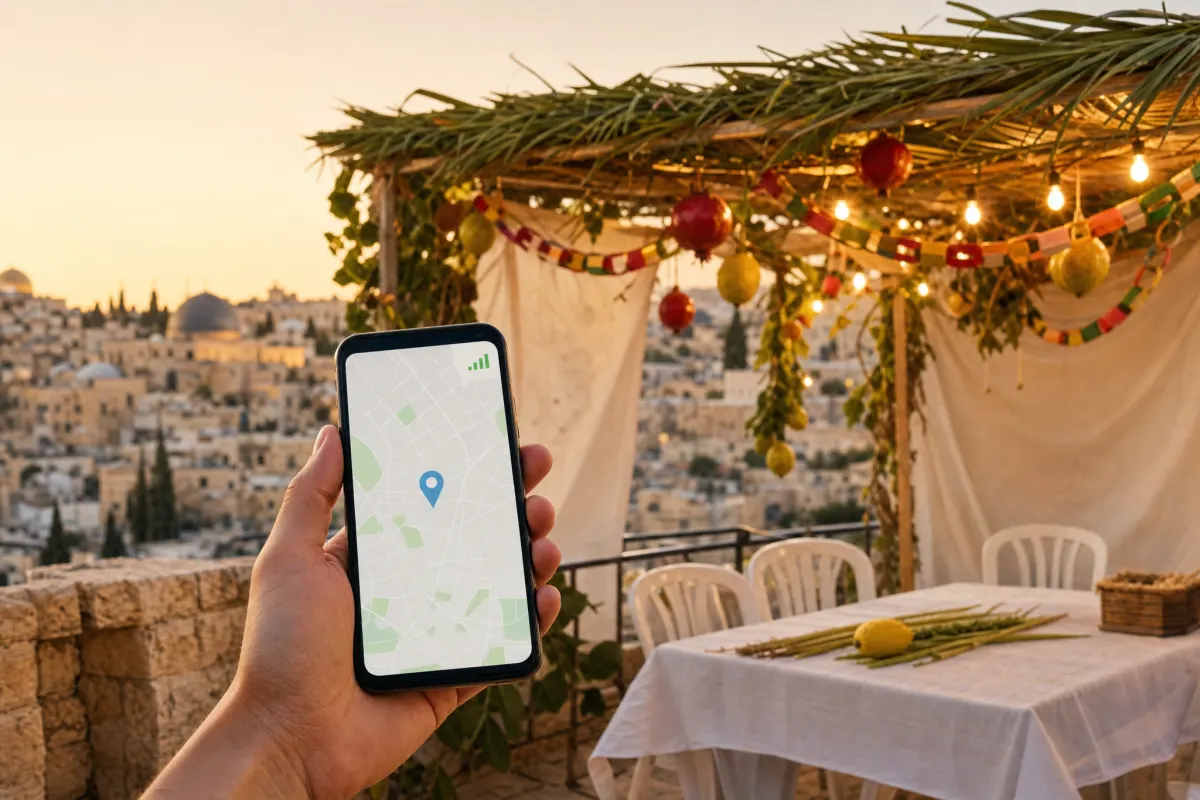
- 4At the Kotel or on the Jerusalem March, set a meeting point and share your live location before joining the crowd. On long drives, share your connection with a tablet.
- 5Use your Israeli number — included in every plan — to book a sukkah table, a taxi or a delivery: businesses answer local numbers more willingly.
Yom Kippur with a phone in your pocket
Networks keep working on Yom Kippur, but the streets are silent and, in many neighbourhoods, using a phone in public is frowned upon. Keep it on silent, step aside to call, and video-call family abroad before the fast begins on Sunday afternoon or after it ends on Monday evening.
Which plan for an October 2027 trip
- A week around Sukkot: a short-trip plan covers maps, messaging, photos and calls.
- From Rosh Hashanah to Simchat Torah: pick a plan that covers the whole month, so you never top up on a holiday.
- Living in Israel: a monthly plan with no commitment keeps the same Israeli number, and you can bring your current one.
Every prepaid plan includes 4G/5G data on the Partner network, a real Israeli (+972) number and unlimited calls and texts in Israel. An AI assistant replies on WhatsApp at any hour; advisers work Sunday to Thursday 9:30–19:30 and Friday 9:30–14:00 (Israel time), closed on Saturdays and Jewish holidays.