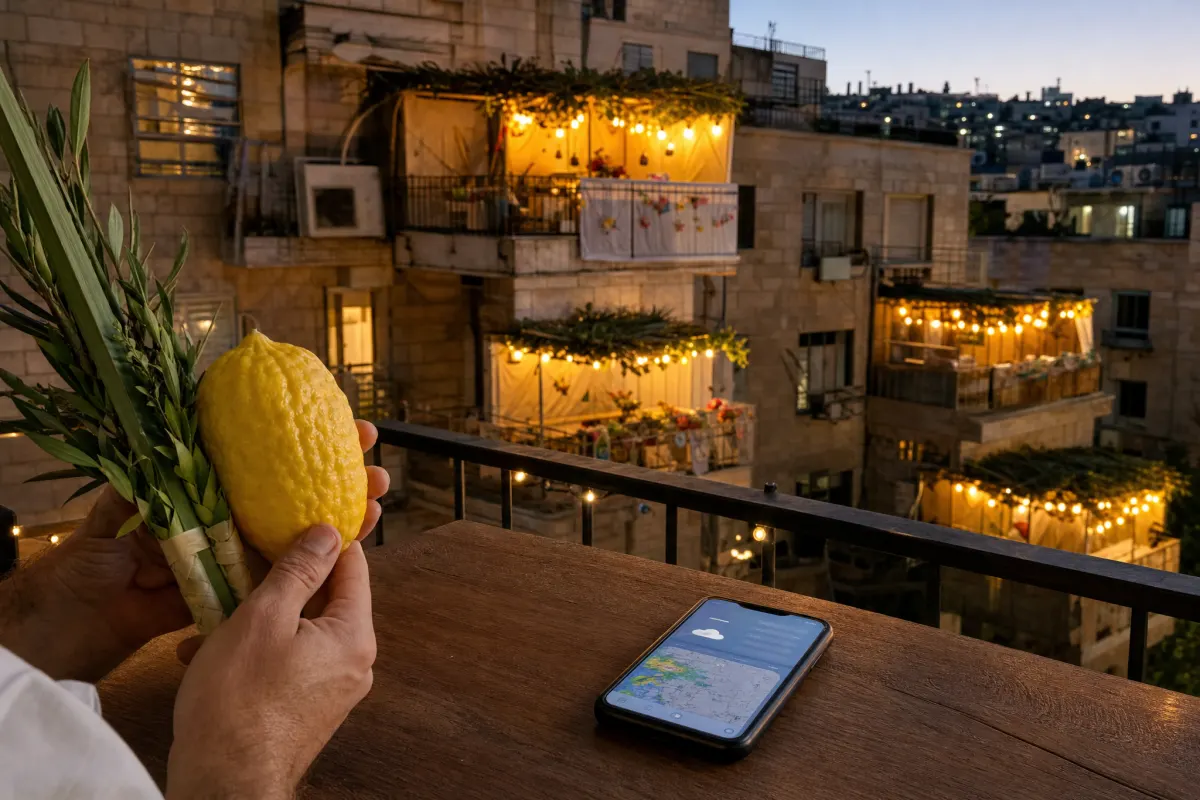
Sukkot is the busiest holiday week of the year in Israel. Schools are off, many offices slow down, and families head for the Galilee, the Golan, the Dead Sea and Jerusalem. Whether you are visiting or living here, this is the week when a working phone matters most: you navigate unfamiliar roads, coordinate with family at crowded sites and book last-minute tables — often on days when phone shops are closed.
Sukkot 2026 dates in Israel
| Date | Day | What it means in practice |
|---|---|---|
| Friday 25 September | Erev Sukkot | Shops close early in the afternoon; buses and trains stop before sunset. |
| Saturday 26 September | Sukkot, first day (also Shabbat) | Full holiday: no public transport, most shops and phone stores closed. |
| Sunday 27 September – Thursday 1 October | Chol HaMoed | Intermediate days: shops, attractions and public transport run, with heavy domestic tourism. |
| Friday 2 October | Hoshana Rabba | Short day: everything winds down by mid-afternoon. |
| Saturday 3 October | Shemini Atzeret – Simchat Torah (also Shabbat) | Full holiday: no public transport, most shops closed; transport resumes after nightfall. |
One day, not two
Outside Israel, Shemini Atzeret and Simchat Torah are two separate days. In Israel they fall on the same day — Saturday 3 October 2026 — so the holiday ends a day earlier than abroad.
Getting ready for your trip to Israel?
Pick a plan that matches how long you are staying, and arrive already connected.
- from $28.99Choose
Basic · 20 GB
7 to 60 days
- from $34.99Choose
Medium · 50 GB
Most popular - from $44.99Choose
Pro · 100 GB
7 to 60 days
- Israeli number included
- eSIM by email in 2 minutes
- WhatsApp support
What is open and what is closed
The rhythm of the week is simple: the first and last days are full holidays, and the days in between are ordinary working days with a holiday atmosphere.
- Public transport: buses and Israel Railways stop from the afternoon of Friday 25 September until Saturday night, and again from the afternoon of 2 October until the evening of 3 October. During Chol HaMoed they run, often crowded.
- Shops and malls: closed on the full holiday days in most cities. During Chol HaMoed most are open, sometimes with shorter hours.
- Phone shops and SIM counters: closed on the holiday days — a good reason to sort out your mobile line before the holiday rather than on arrival.
- Ben Gurion Airport: stays open. Some airlines do not fly on Shabbat and holidays, but many foreign carriers do.
- Taxis: available, but fewer on the holiday days; ride-hailing apps are the easiest way to find one.
Where the crowds are
Chol HaMoed is the peak of domestic tourism. Expect packed roads to the north, full car parks at national parks and nature reserves, and long lines at popular attractions.
- Jerusalem: the Priestly Blessing (Birkat Kohanim) at the Western Wall during Chol HaMoed draws tens of thousands of people, and the traditional Jerusalem March fills the city centre.
- The Galilee, the Golan and the Sea of Galilee: campsites, hiking trails and beaches are at their busiest.
- Public sukkahs: hotels, restaurants and many municipalities set up sukkahs where visitors can eat.
Very large gatherings put pressure on mobile networks: when tens of thousands of phones share the same antennas, data can slow down for a while. Plan for it rather than rely on it.
Staying connected during Sukkot
- 1Install your eSIM before the holiday. It arrives by email as a QR code and activates in about two minutes — no shop, no queue, which matters on days when stores are closed.
- 2Keep your home SIM active for bank codes. On a dual-SIM phone, use the eSIM for Israeli data and your usual line for SMS from your bank.
- 3Download offline maps of the areas you will visit before heading to crowded places such as the Western Wall.
- 4Agree on a meeting point and share your live location with your group before you arrive — not once the network is saturated.
- 5Use an Israeli number to reach restaurants, sukkah hosts and drivers: local numbers get answered more readily than foreign ones.
Visiting an observant family?
In many religious homes, phones are not used on the holiday days themselves. Put yours on silent, step outside the sukkah for calls, and make your holiday video call to relatives abroad before candle lighting or after the holiday ends.
Which plan for a Sukkot trip
- A week's visit over the holiday: a short-trip plan covers navigation, messaging and photos.
- Staying through both holiday weekends: choose a two-week plan so you are not topping up on a closed day.
- Living in Israel, or staying for months: a monthly plan with an Israeli number keeps you on the same line all year.
Whichever you choose, the QR code arrives within minutes of payment, so you can still get online the evening before a holiday.